
Arthur Leslie Morton (‘Leslie,’ to his friends) was a twentieth-century English historian, literary critic, poet, and Communist. He is best known for his book with a very influential title—A People’s History of England (1938)—and was a pioneering (if sometimes forgotten) figure in the critical study of millenarianism and apocalypticism, history from below, utopianism, and English culture.

Morton was born in 1903 at Stanchils Farm near Bury St Edmunds. After being tutored at home, Morton attended King Edward VI Grammar School at Bury St Edmunds which had a typical royalist, Anglican, and imperial ambience, with an Officer Training Corps established in 1908. An extensive annotated photographic archive, including numerous photographs of the buildings and school life from around Morton’s time is available here.
When he was 15, Morton was sent to Eastbourne College on the south coast of England. The First World War intensified the militaristic and imperialist concerns of the college, and an interest in the role of warfare in English history would remain an ongoing feature of Morton’s later scholarship. Pictures of the College life can still be found on the college’s old website.
Morton’s politics were also moving leftward around this time, though with a (small ‘c’) conservative bent. Among the many books he was reading, Jack London’s The Iron Heel was the one he viewed as lifechanging for a seventeen-year-old coming to terms with socialist ideas. Soon after, he moved onto William Morris’s News from Nowhere followed by Marx and Lenin.
Morton attended the University of Cambridge (1921–1924) where he studied History and English. His developing political ideas flourished in an environment where such views could be discussed more openly (though still controversially) in light of the Russian Revolution and growing labour militancy. He joined the Cambridge University Labour Club and became involved in emerging socialist networks. During his time at Cambridge, T. S. Eliot published ‘The Waste Land’ (1922), an account of societal decline that influenced Morton’s socialism (and other socialists), despite Eliot moving in the opposite political direction. Morton increasingly saw revolutionary transformation of the sort associated with the Soviet Union as the answer to the crisis of capitalism outlined by Eliot.

After Cambridge, Morton took up a teaching post in 1924 at the grammar school in Steyning, a conservative market town. Despite disliking his time in Steyning, he met the poet, publisher, and eccentric, Victor Neuburg (aka ‘Vickybird’), also an ex-follower of the occultist Aleister Crowley. Because of this connection, Morton published a thoroughgoing materialist and Marxist reading of the history of magic in his minor publications of the 1920s and 1930s. The pair also discussed English radical history and it was through Neuburg that Morton developed his interests in William Blake.
After supporting the General Strike of 1926, Morton was made redundant from Steyning Grammar School. He moved closer to home (Leiston, Suffolk) to work at A. S. Neill’s progressive Summerhill school. Morton was impressed by the school’s resistance to teaching children prevailing capitalist values. Here Morton met his first wife, Bronwen Jones, and after marrying in 1928 they moved to London as new members of the Communist Party of Great Britain (CPGB). By 1934 the couple split, and Morton settled down with (and later married) Vivien Jackson, daughter of the working-class autodidact and Communist intellectual, T. A. Jackson.

In 1930s London, Morton was engaged in menial work for the Communist Party, which he saw as essential training for its intellectuals. Morton began employment with the Daily Worker (the new national Communist newspaper) and for a time was named as its Proprietor, i.e. the named person who would go to court and potentially prison in the case of legal attacks on the newspaper. The closest he came to prison was when William Joyce (later Lord Haw Haw) and the British Union of Fascists alleged that the Daily Worker was inciting violence against a fascist rally. Fortunately for Morton, the magistrate rejected the claim.
Throughout the 1930s, he also published reviews and articles on history, literature, and politics in the Daily Worker and in literary journals such as The Criterion (run by Eliot) and Scrutiny, including Marxist understandings of: English and European history, English literature, the transformation from capitalism to socialism, human relations in a post-revolutionary society, and anthropology of religion.
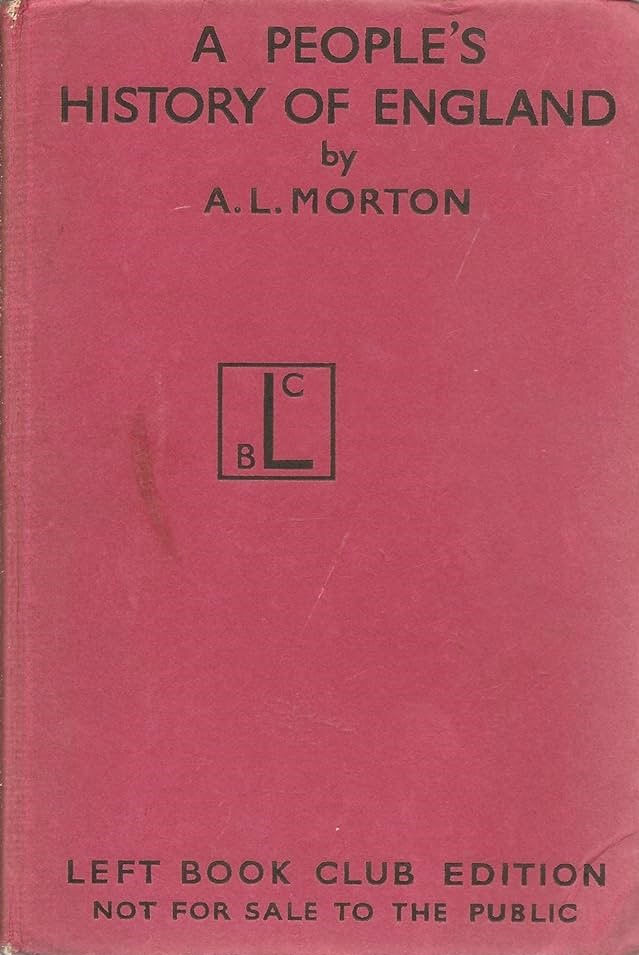
In 1938, Morton published A People’s History of England. This was probably the first sustained Marxist history of the nation and was emphatically historical materialist in presentation. That is to say, A People’s History of England provided an account of the transformation from ancient modes of production to feudalism and then capitalism, and the rise of the working class and potential in-breaking of a new era of socialism. The seventeenth-century English Revolution played a crucial role in this history, including the accompanying apocalypticism and millenarian movements, some of which he dismissed as making strategically inept demands too ahead of their time to be realised. This was part of a broader emphasis in A People’s History of England which reflected the Popular Frontism of the late 1930s, i.e. a concern for the importance of broad anti-fascist alliances and harnessing of national progressive traditions to enable historical progression.
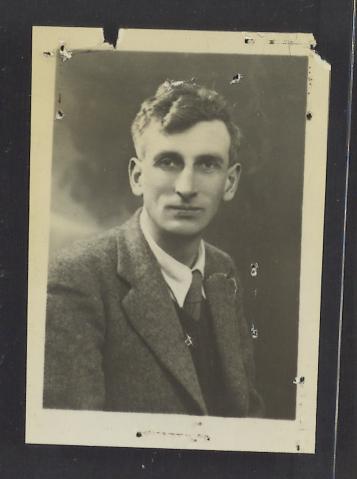

By the start of the Second World War, Morton moved back to Leiston where he was part of a small but thriving Communist culture led by the artist Paxton Chadwick and centred around the local newspaper, the Leiston Leader. Morton combined organising for the Communist Party with army service (mostly labouring on the strategically important Isle of Sheppey). While he inevitably wrote less, Morton still developed ideas about utopianism and started re-evaluating his views on the value of future transformation in religious thinking and millenarianism. Some of these ideas were included in his short collection of essays, The Language of Men (1945).
After the War, Morton had a short stint as a local councillor (1947–49) and was a key figure in the founding of the acclaimed Communist Party Historians’ Group. The Historians’ Group included figures who became major historians, such as Christopher Hill, Eric Hobsbawm, Rodney Hilton, Dorothy Thompson, and E. P. Thompson. One of the reasons the group was founded was to revise A People’s History of England and a new edition was published in 1948.
The heyday of the Historians’ Group (1946–1956) was marked by an intense concern for understanding national history in relation to historical materialism, as well as the development of history from below and the idea of an English radical tradition. Morton led the way in his study of seventeenth-century religious sects, the growth of the labour movement and its precursors in pre-modern radicalism, and the history of utopianism.

His major publication in this era was The English Utopia (1952) which traced the history of utopian thinking and utopian literature in relation to peasant hopes, the rise of bourgeois thought, and the emergence of socialism. In doing so, Morton now put greater stress on the significance of lost causes and utopianism, and how their progressive potential could be taken up by the twentieth-century working class in the face of a conservative postwar turn and American imperialism.

In 1950, the Mortons moved to The Old Chapel in Clare, Suffolk, where they lived for the rest of their days. There is a website with a history and gallery dedicated to The Old Chapel and a watercolour of the house painted by Walter Spradbery in 1958 is on the website of the William Morris Gallery. While rural life, writing, and local party organising suited Morton, he was also involved in international political developments. The denunciation of Stalin by the new Soviet leader Khrushchev in 1956 was the most significant and Morton was part of a CPGB delegation sent to the Soviet Union to assess the state of socialism there. Along with the Soviet military intervention in Hungary and debates over inner-party democracy, the fallout from Khrushchev’s speech led to a sharp loss in CPGB members (though followed by a recovery), including members of the Historians’ Group (e.g., Hill, the Thompsons, Hilton).

Morton, however, stayed and continued to develop his thinking on apocalypticism and millenarianism, including a study of William Blake—The Everlasting Gospel (1958). His research on seventeenth-century millenarian and political ideas associated with the ‘Ranters’ took off in the 1950s, culminating in The World of the Ranters (1970). In the 1960s, Morton continued to reassess the significance of utopianism and lost causes in work on Chartism, Robert Owen, and the history of British socialism. While mostly a collection of essays providing a Marxist history of literature and the growth of the nation, The Matter of Britain (1966) also included his work on Blake and a general essay on utopianism.

Morton was a critic of what he saw as the Soviet invasion of Czechoslovakia in 1968 and wrongful interference in another socialist country (the very language of ‘invasion’ vs ‘intervention’ was loaded in inner-party debates of the time). While this and the cultural, economic, and political shifts towards postmodern and neoliberal capitalism fed into the sharp disputes which eventually brought an end to the CPGB, Morton remained committed to the legacy of the Bolshevik revolution, unlike influential tendencies on the left and in the CPGB in the 1970s and 1980s. He formulated his ideas about a delayed future for socialism through his work on William Morris, in particular.


Morton was a regular visitor to Eastern Europe, especially the German Democratic Republic, and he was awarded an honorary doctorate from Wilhelm Pieck University Rostock in 1975. He maintained these networks in his final years and gave his (not inconsiderable) library to the university library at Rostock.
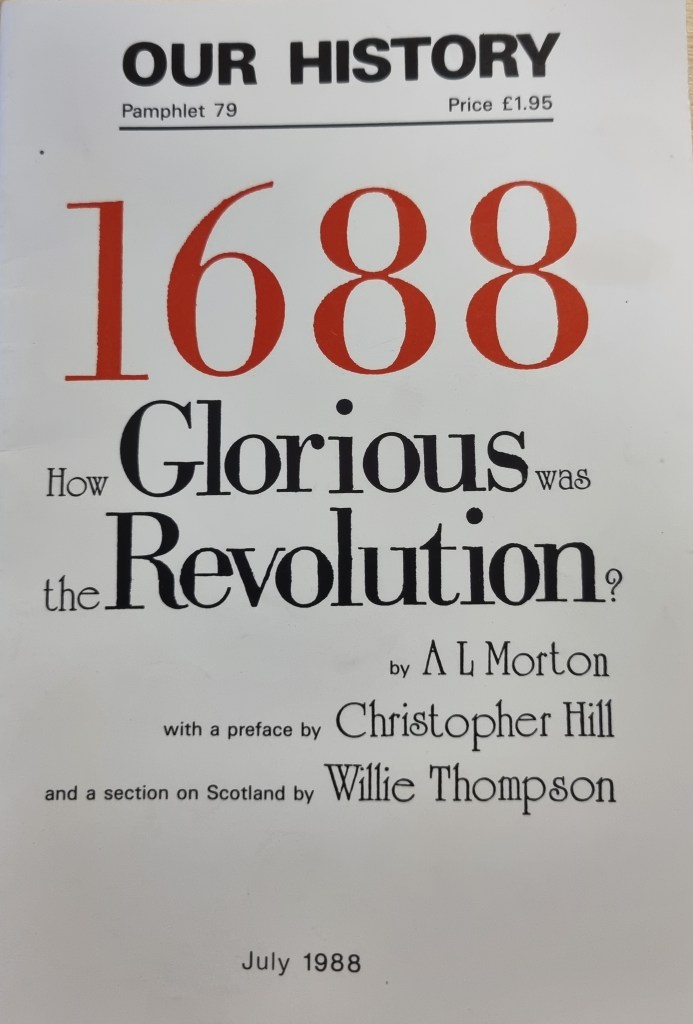
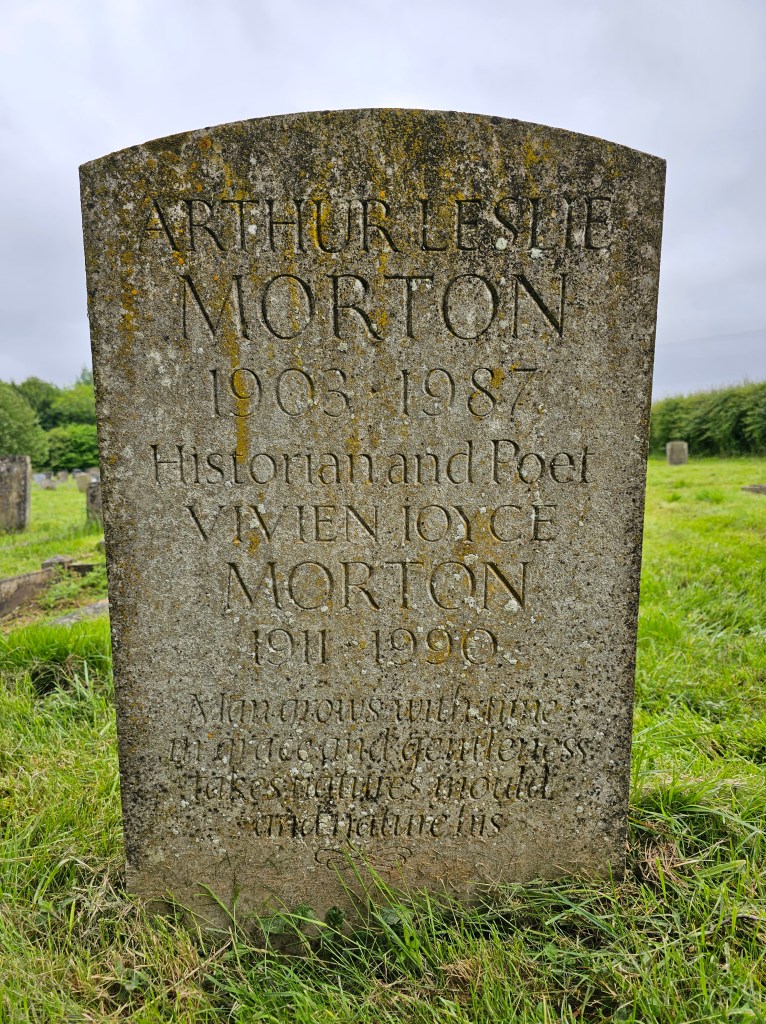
He died on 23 October 1987 at The Old Chapel while writing his final booklet on the fate of seventeenth-century radicalism and the so-called ‘Glorious Revolution’ of 1688. He is buried with Vivien (d. 1990) next to the grave of Tommy Jackson (d. 1955).
 English Radical Tradition